Beluga chef's knife
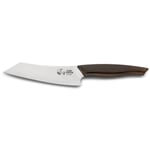
Beluga chef's knife
- Highly functional chef's knife: made from stainless knife steel
- Curved cutting edge: also ideal for cradle cutting
- Easy to grip and pleasant to the touch: smoked oak handle
General Information
Harmoniously balanced. For precision in every movement
Discovering the right chef's knife is a lasting experience, as it can be much more than a simple kitchen tool: once picked up, it clings to your fingers and palm and naturally becomes an extension of your own arm, every movement is fluid and every cut is perfect. In order to find the right chef's knife, one that you can say is comfortable and balanced in your hand, there are a few important criteria to consider. First and foremost, this includes the size of your hand, but also the size of the chopping board you prefer to use and the question of whether you often cook large or small meals. The fine chopping of onions, garlic, herbs and the like, one of the most frequent tasks of the chef's knife in everyday kitchen use, can be carried out more quickly with a shorter, more agile blade, as the cutting paths are shorter and precise cutting movements can be directed more quickly. A shorter blade is therefore considered particularly beginner-friendly in a chef's knife, while professionals who value precise cutting also appreciate the high level of control over the blade. When larger quantities need to be processed in a single cutting movement or voluminous food needs to be cut, chefs then reach for the longer blade. The chef's knives from the "Beluga" series from the Solingen-based Paul Adrian knife workshop are characterized by a very sharp, slightly curved cutting edge. The blade, which is typical of a European chef's knife, is suitable for both the pulling and the cradling cut. You can use it to quickly and evenly process your food - from vegetables and herbs to fish and meat - while the knife sits securely in your hand thanks to a rounded recess at the transition to the handle (as a finger guard).
Stainless steel blade. In superior hardness
Stainless blade steel is known for its good balance between hardness and corrosion resistance. In the kitchen, it is a definite advantage that stainless blades do not tarnish on contact with liquids containing fruit or lactic acid and do not need to be cleaned intensively or protected with oil after use. (Simply wiping with a damp cloth is often sufficient.) The Solingen-based knife manufacturer Adrian has therefore opted for Swedish chrome steel for its in-house chef's knife series, which has a relatively high carbon content for a stainless steel and a hardness of 59 HRC. The blades made from this steel are not only rustproof, they also have excellent edge retention and are comparatively easy to resharpen. In addition, the cutting edges can be ground thin: in the case of the chef's and barbecue knives, even up to a trigger angle of 12.5°. When designing the blade shape of such sharp knives, the manufacturer considered how to ensure a high degree of versatility and therefore opted for a gently curved cutting edge. The transition between the blade and handle also has a special feature: an elegant curve that acts as an effective finger guard, so that the Beluga knives do not require a bolster. This in turn has three advantages: a lower overall weight, the bolster is not in the way when cutting and the blade always comes to rest on the cutting board in its entire length (even after many years of use and frequent resharpening).
Well thought out. From the blade to the handle
A good knife not only impresses with the sharpness and edge retention of its blade. In addition to the shape of the blade, the design of the handle is also decisive - and not least the material from which the handle is made - because a knife that is intended to give pleasure every day must fit well in the hand. For the handles of the "Beluga" knife series, Solingen-based knife manufacturer Adrian uses wood from local oak trees, which is refined in a special smoking process. The result is a deep brown color, and the treatment makes the wood durable, resilient and moisture-resistant. However, the fine grain remains. It provides additional grip and makes each knife unique. The pleasant feel of the smoked oak matches the curved shape of the handle. The knifemakers were inspired by beluga whales, whose streamlined bodies allow them to move with playful ease through the cool waters of the Arctic Ocean. The handle geometry, which captures the curve of their body shape, lays the foundation for low-fatigue cutting. Even a large knife, such as the stately bread knife from the Beluga series, can be held securely and relaxed, allowing you to work powerfully.
A living Solingen tradition. Always rethought
The beginnings of blacksmithing in Solingen date back to the Middle Ages. What began with the forging of swords soon developed into the sharpening of a wide variety of knives, and not long afterwards scissors were added, which became sought-after goods far beyond the region. At the beginning of the 20th century, razor blades were in demand. Paul Adrian, founder of the steel goods factory of the same name, also began manufacturing scissor blanks in 1901 and shifted his focus to razors in the 1920s. In the 1950s, the next generation refocused the sharpening business on the production of steak knives - a focus that the family business, now headed by Rainer Adrian, further expanded in the 1970s in the third generation. During this time, the close cooperation with another Solingen-based family business, which is also closely associated with blade grinding, also developed. In 2017, the baton was handed over to Frank Buchmüller, who merged the companies and now manages production together with his daughter Jessica. Building on the long tradition, the "Beluga" kitchen knife series from Paul Adrian Stahlwarenfabrik was created. With the fresh design, the two Buchmüllers are deliberately setting a new impulse, but in keeping with the Solingen art of knife forging and sharpening, the motto remains the same: every blade is blue-blued, honed and honed by hand.
Note:
The smoked oak knife handle is unique. The natural grain and color can vary. The following also applies: High-quality knives should not be put in the dishwasher (regardless of whether the blade is labeled as stainless). To clean after use, simply wipe with a damp cloth and then store in a dry place. We recommend the occasional application of a little cooking oil to maintain the wooden surface.
Product Information
Article Number 218859
- Highly functional chef's knife: made from stainless knife steel
- Curved cutting edge: also ideal for cradle cutting
- Easy to grip and pleasant to the touch: smoked oak handle
Blade Sandvik steel (Alleima 12C27M). Smoked oak handle from the Spessart. Made in Germany.
Blade L 15.5 cm. Total L 29 cm. Weight 123 g.
Have a question?
If you have a question concerning this product you are welcome to contact us. For this your E-Mail program will open.


Contact Us
For advice, spare parts or special requests - our customer service will take care of your questions and concerns, personally and competently.
You can reach us from Monday to Friday at +49 2309 939095 or anytime at info@manufactum.com

Gift Certificates
It is good for everything: With our PDF gift certificates you can choose from the entire Manufactum selection. Pick a motif which you can send by email or print out and present personally, immediately after submitting your order.
Order now