Manufacturer
Fagus. Wooden toys from conviction


Wood contains everything a good toy needs: With this conviction, the Fagus brand has stood for high-quality wooden toys since 1982, so robust that they can be passed down from generation to generation. Knubbelauto, shovel excavator and playground: The wooden toys are made by hand in a workshop for people with disabilities in North Rhine-Westphalia. But what exactly does this craft look like and who are the people who do it? We set off and paid a visit to Fagus: "And bang! And bang! And bang!" Armed with a glue bottle and a hammer, Sven comments on every single step of the work he carries out. He is clearly delighted to be able to show us how skillfully he assembles the wheels and rims of the wooden truck. All around us, we see excited and happy faces. Christine waves us over and then looks intently at a mushroom-shaped piece of wood again. She examines the surface with her thumb, turns and twists the piece and finally throws it into a box that is already a third full of pins. "Seen it?" she gestures with a grin. Oh yes, seen it, but what is it? "That's the stopper for the axles," explains site manager Georg Hülsbrink. Christine checks every single stopper for small defects in the wood, sanding or paintwork. Only what she finds to be good can be assembled. The site manager laughs and jokes around with Ralf, who tirelessly puts tires on rims while we continue to look around the workshop.


Short fibers, long life: Beech wood


Back in 1969, the German Caritas Association founded the Büngern-Technik sheltered workshop for people with disabilities in Rhede-Büngern. Initially, the employees produced cords and made up cloths. Their work was in demand right from the start, Büngern-Technik grew with the order situation, the number of employees increased and the premises were repeatedly extended and expanded. The decisive step was taken by the Caritas Association when it took over a wooden toy factory in 1981 - thus laying the foundations for the Fagus brand. The name is no coincidence. When you hold a Fagus wooden vehicle in your hands today, the first thing you notice is its solidity. This is not only due to the sheer size - Fagus also makes small toys for the youngest hands - but also to the material: the workshop only uses wood from the local copper beech (Fagus sylvatica). This is why a horticulturalist friend suggested the brand name Fagus, the Latin name of the beech genus. The copper beech, the most common deciduous tree in Central Europe, provides a natural raw material that is constantly growing and does not require long transportation routes. In the toy industry, the extremely hard and strong copper beech has become the most widely used wood - even if one should be familiar with the peculiarities of this wood. The short-grained copper beech wood is a little diva and is known to have a life of its own, it works a lot and tends to bend. It is therefore less suitable as construction wood, but is perfect for durable, robust wooden toys thanks to its hardness and strength. Fagus processes kiln-dried wood, which is put through its paces - or rather, checked for cracks and grain - at every stage of the process.
Many small steps for the big picture
And there are many, many steps that every single wooden toy goes through. Georg Hülsbrink can't even tell us right away how many there are in detail, because: "Every toy is different. And the work steps for each product are planned according to people's individual abilities. It can get very detailed. But that's the way it is, because one thing is particularly important to us: we focus on supporting people with disabilities." And so, with the help of templates, they saw, plane and chamfer, drill and sand, paint and hammer, dovetail and glue and even shake, and everyone contributes to the end product according to their own style and ability. Impressed, we stand in front of the large chainsaw that cuts the 3.50 meter long beech planks to a length of 1.50 meters - the perfect size to become a component of a Fagus toy. Dietmar, on the other hand, is completely unimpressed as he patiently feeds one plank after the other into the multirip saw, which saws them into narrower strips, while Jonas receives the strips on the other side of the saw and carefully stacks them on pallets. In the four-sided planer, the individual slats are planed from all sides, then chamfered (the edges beveled) and sanded for the first time - and only then, after further inspection, is the decision made as to how the respective wood will be further processed. Each hole is drilled individually and each edge is processed separately. As we walk through the workshop, we learn that a sanded chamfered edge not only feels nicer, but above all can be painted better, that a hole is always drilled from both sides so that the wood does not tear out on one side, and Lena enthusiastically explains to us how she optimally applies the template and why she protects her hands with gloves.


Precision cutting on the sliding table saw


Each workpiece undergoes a final inspection


During tire fitting
Prudent craftsmanship

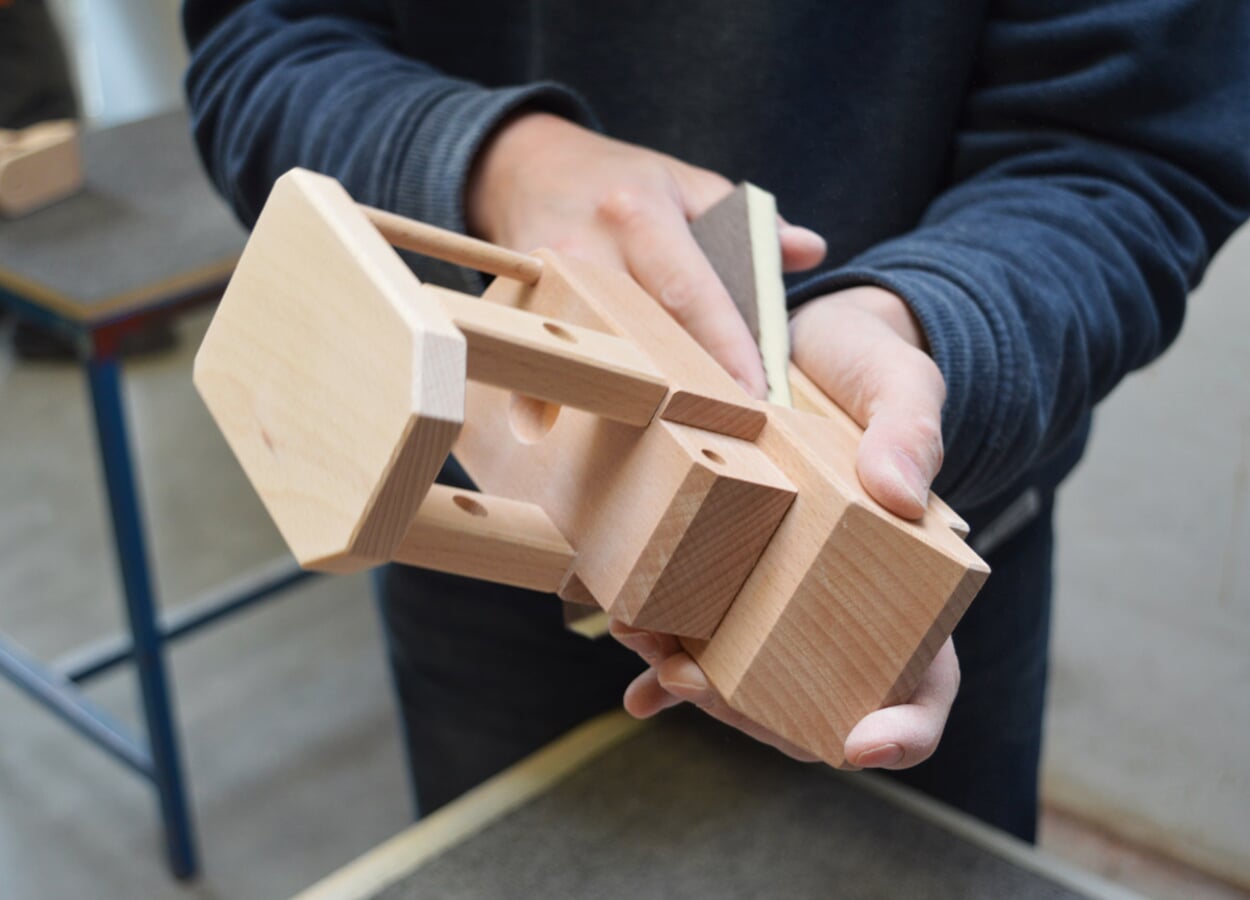
In general, it is the joy that is evident everywhere that also carries us away. Whether in the machine hall or in the paint shop, whether in assembly or in final inspection and packaging: the employees are obviously happy to be working, there is a lot of joking and laughing and we are always being waved at because Susanne or Thomas or Stefan want to show us their work. They are all openly happy about our interest in their craft. After all, they are showing us real carpentry. So expertly that not even metal parts such as screws or nails are needed to join the components together. Instead, the wood is dovetailed, dowelled (with wooden dowels, of course) and glued together. Gerd-Josef excitedly invites us to take a closer look as he works on the body of a wheel loader with a sanding sponge, again and again, until he decides that it is now smooth and clean enough. "But it's only just been painted, hasn't it?" we ask in amazement. Just a few minutes ago, we were watching Alfred spraying on the water-based varnish with a spray gun and carefully placing the varnished parts on a tray to dry. "Yes, of course, and that's where the peculiarities of beech wood come out again: the short fibers stand up after varnishing, so the surface of the wood feels a little rough again. That's why we sand again and varnish again. Some wooden parts also go into the vibrating machine." The vibrating machine? It turns out to be a so-called vibratory finishing machine. Its vat is filled with a grainy abrasive (which looks like coarse gravel to our layman's eyes), which is thoroughly shaken. The piece of wood is simply placed in the vat, pulled under the surface by the shaking as if in a grinding stream, and is literally polished by the abrasive as it dives in. But how do you find it again? Hülsbrink laughs. "It comes back up on its own. Caroline keeps a close eye on the tub and grabs it when it resurfaces. This makes the wooden surface as velvety and smooth as a baby's bottom." Incidentally, we learn that the vibratory finishing machine can also be used for varnishing: "This is called drum varnishing. It is particularly ideal for small wooden products such as the Fagus Minis."
Production according to skills
Just before we leave the workshop, we take another look over Susanne's shoulder. She is conscientiously threading the rope guide on a high crane, which is no easy task. She reminds us again that at Fagus, every employee is deployed according to their abilities. But what happens if Susanne is on vacation or even absent due to illness? "It's true, our planning is relatively complex," smiles the site manager. "If an employee is absent, for whatever reason, then of course we also have to adapt the work process. It's like in any other company. The only difference is that we can't assign our employees to just any workplace. Everyone works according to their abilities. And that means that there are days when we don't have anyone to thread the rope guide, for example." And then what? "Then we redistribute the tasks and continue working on another wooden toy if necessary. We don't work in series production. As I said, the focus here is always on supporting people. In everything we do. And we always have a task that our employees can fulfill."
With pleasure for a lifetime


Tasks that are carried out with care and diligence, as befits a skilled trade. With knowledge and expertise, when the skilled and pedagogically trained group leaders guide and support the employees. Without spit, but with patience, glue, wooden dowels and occasionally a bit of shaking. And in the end, it's not just a cleverly designed, solidly built and extremely robust wooden toy: from start to finish, it's people who have a place in life and in our midst, who take responsibility and do something meaningful - not despite their disability, but with it. They work proudly and usually very happily to ensure that you and your children can feel the velvety surface of the wood, see the natural grain and, last but not least, experience the long-lasting functionality of a Fagus wooden toy. At the end of the day, Georg Hülsbrink tells us just one thing: as robust as a Fagus wooden toy is, it hurts his soul if he sees it lying in the rain. Of course the toys can be repaired, the individual parts and even the rope guides can be replaced, of course beech wood is very dense and tough - but it is not made for a permanent outdoor existence. Your offspring can play with it on the lawn and in the sandpit at any time, but in the evening the toy should be brought back indoors. Then you can be confident that your Fagus wooden toy will inspire imaginative play for generations to come.
All wooden toys from Fagus at a glance
Recommended Topics

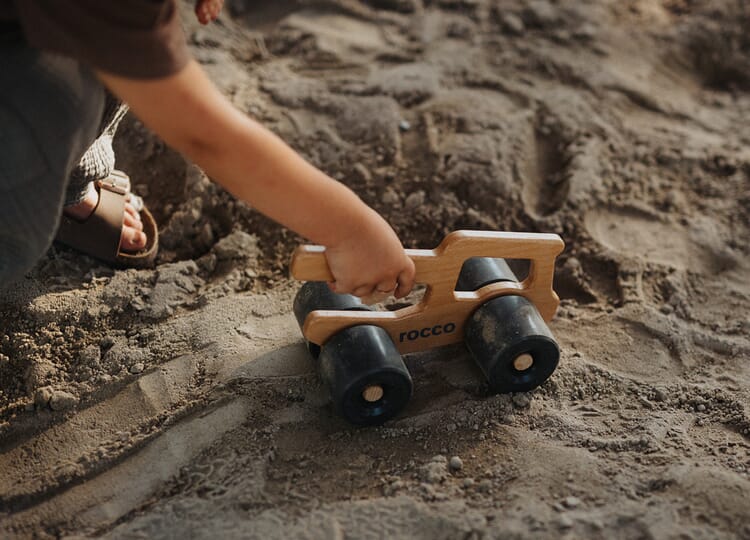
We offer toys made of natural or steamed and / or oiled wood, as well as colorful models painted with non-toxic paints. As a rule, beech is the wood of choice. This is because beech wood is ideal as a material for wooden toys: it is light, neither too hard nor too soft, and does not splinter. In addition, beech wood is one of the most sustainable woods, because beech is fast-growing and the most common deciduous tree in our native forests.
View more

The wooden toys from the Württemberg-based manufacturer Naseweiss combine the joy of play with the opportunity to learn about principles from nature, technology and culture - from the physical principle of the pulsar motor to a simple magnifying glass or a light microscope to a sundial. They invite intensive engagement with nature and the environment, while at the same time leaving room for the children's own ideas and discoveries and encouraging creative play.
View more